What the land carries
Vancouver’s downtown eastside, (known as the DTES) is the site of the worst of the city’s inequities. It’s a place where addiction, poverty, violence mental illness and homelessness coexist with its resident’s acts of community care and solidarity. This neighbourhood stands in severe contrast to the extreme wealth, privilege found in Vancouver and is considered an eyesore by many.
Growing up in Vancouver, with my own struggles with trauma, mental illness, addiction and self-harm, while attending high school downtown, led me to being closer to the realities of the DTES. With my father being a TV news cameraman and my uncle being an unhoused Indigenous man, I was exposed to many of the hard realities of street life and police violence quite young. My Nepalese ex-husband died of a drug overdose here.
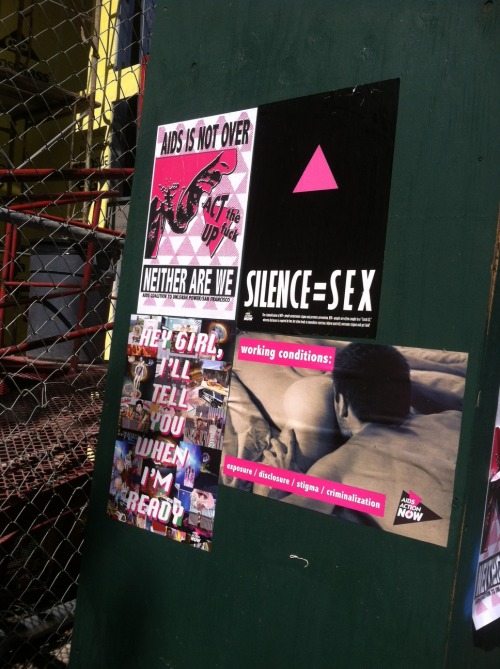
As an adult, I left British Columbia but continued to live with oppression through my personal experiences, my extended community and communities I worked with. Queers in my world experience injustices due to being trans, HIV+, disabled, living with addiction, racialized, colonized, sex workers, poor, mentally ill and living with varied intersectional identities. I have used art as a tool of resistance and community building in my frontline work in prisons, and with people in conflict with the law. My life and work were based in community care and collaboration.
Returning to Vancouver, I’ve had to navigate isolation and layered trauma within a city that mirrors both my history and the systemic violence I critique.
Generating Resistance
I use Ai generation not as a tool of progress but as a mirror of the systems it comes from:
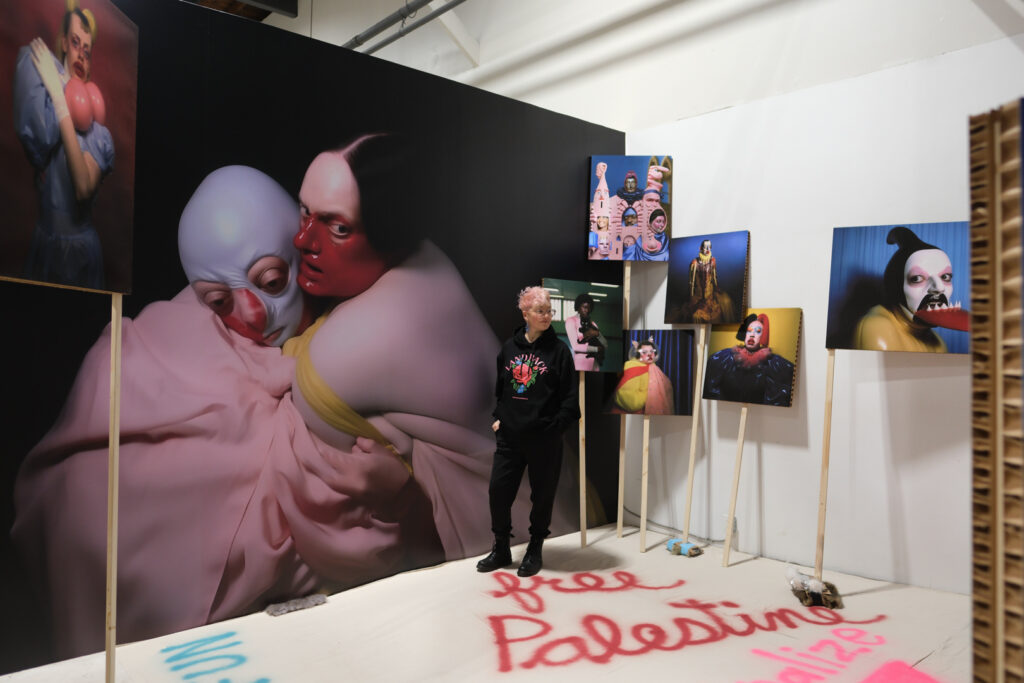
Systems that extract data, labour, and imagination without consent. I use these technologies to illustrate trauma, dissociation, and queerness. The grotesque figures, part animal, part human – Boschian rendering of a digital age – reveal horror and tenderness, a queer divinity. Among them, the “Whale Drag” imagined the Orcas in a resistance movement against the ultra-rich, performing defiance in a maritime city built on speculative wealth. Depictions of the grotesque were placed beside ‘whale drag’ images that imagine the Orcas as a resistant movement we want to emulate.
The installation combines these printed images, existing between protest signage and commercial advertisement, stakes in the ground, as if announcing upcoming real estate development. They rest on pedestal-sculptures made of Amazon boxes, fake fur and duct tape. These materials connect the present to the colonial history of the Canadian fur trade, a reminder that extraction and exploitation have simply changed forms as tech oligarchs dominate all human interaction.
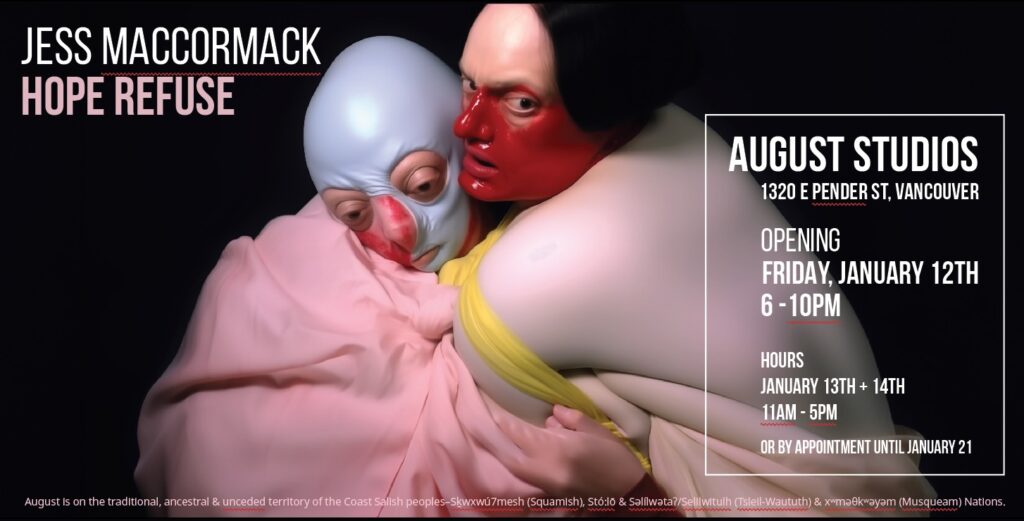
A wall-sized renaissance-esque image of two figures posed as if in struggle, one wearing a gimp mask while the other’s face was partially covered in blood, loomed over the scene.
The floor of the Vancouver gallery was covered in a graffitied canvas with messages like “FREE PALESTINE”, “DECOLONIZE” and “DECRIMINALIZE: HIV, SEX WORK, DRUG USE”. Visitors had to walk over the words to move through the space, an uncomfortable gesture that mirrored the daily erasure and moral contradictions that underpin urban life here.
Technology of Extraction
AI as a medium carries its own ethical collapse. It is built by corporations who accelerate environmental destruction, trained on stolen data, in data centers powered by electricity from stolen rivers. It’s propelled by the same motives that have made cities like Vancouver unlivable for many. It is a machine that embodies capitalism, hunger and apathy.
Still, I wanted to see if meaning can be created and survive inside that system.The installation represents the kind of psychological hellscape we are currently embedded in. Digital dehumanization has become a circus that we play in. Hope Refuse is not a moral statement, it’s a landscape of conflicts, portraying both complicity and resistance. It reflects the terrain of living through overlapping crises. Colonial, environmental, economic, while trying to find a position that is not simply despair. It’s an act of witnessing, a tension between creation and collapse, between hope and refuse.